Waste less.
Machine to tolerance.
Machining a composite mold from solid billet wastes most of the block and takes weeks. We build ours close to shape, so we use far less material and cut away far less, then machine the mold surface to spec. Composite molds in about a week.
Print near-net.
Waste almost nothing.
Cutting a mold from solid billet means paying for the material you throw away and the hours to remove it. We print the mold instead, close to final shape and oversized by a few millimetres, so almost nothing gets cut away. The extruder runs lights out overnight. The mold face is then machined to tolerance before it ships, so you get a true machined surface, not an as-printed one.
finished mold
- 01Machine or build a plug
- 02Lay up the mold over the plug
- 03Finish the mold surface by hand
- 04Only then pull parts
- 01Start from your outer mold line
- 02Print the mold near-net, just oversized
- 03CNC the contour to final tolerance
- 04Pull parts
The same print-then-machine flow shortens production tooling and large one-off parts, not just composite molds.
Composite molds
Near-net printed off your outer mold line and machined to tolerance, ready to pull carbon and fiberglass parts. Our lead capability.
Tooling, jigs and fixtures
Patterns, nests, trim fixtures, and shop tooling printed near-net and machined where it counts. The everyday work that replaces stacked foam and cut billet.
Marine and boats
Molds for the small to medium composite parts that fill a boat, consoles, dashes, seatbacks, hatches, and trim, for builders who keep the hull and deck in house.
Prototypes and mockups
Full-scale functional prototypes and mockups, so a design is proven at size before you commit to production tooling.
Custom furniture
One-off and prototype tables and seating with forms only additive can hold, for furniture makers working a new shape. Prototype and low-run, not mass production.
Aerospace tooling
Layup tools and large components for aircraft programs, backed by an ORB Aerospace shop.
Printed in pellet-fed polymers matched to the job: Dahltram T-100GF glass-filled tooling resin for composite molds, plus ABS-CF, PETG-CF, and PLA. Large-format build envelope confirmed on quote.
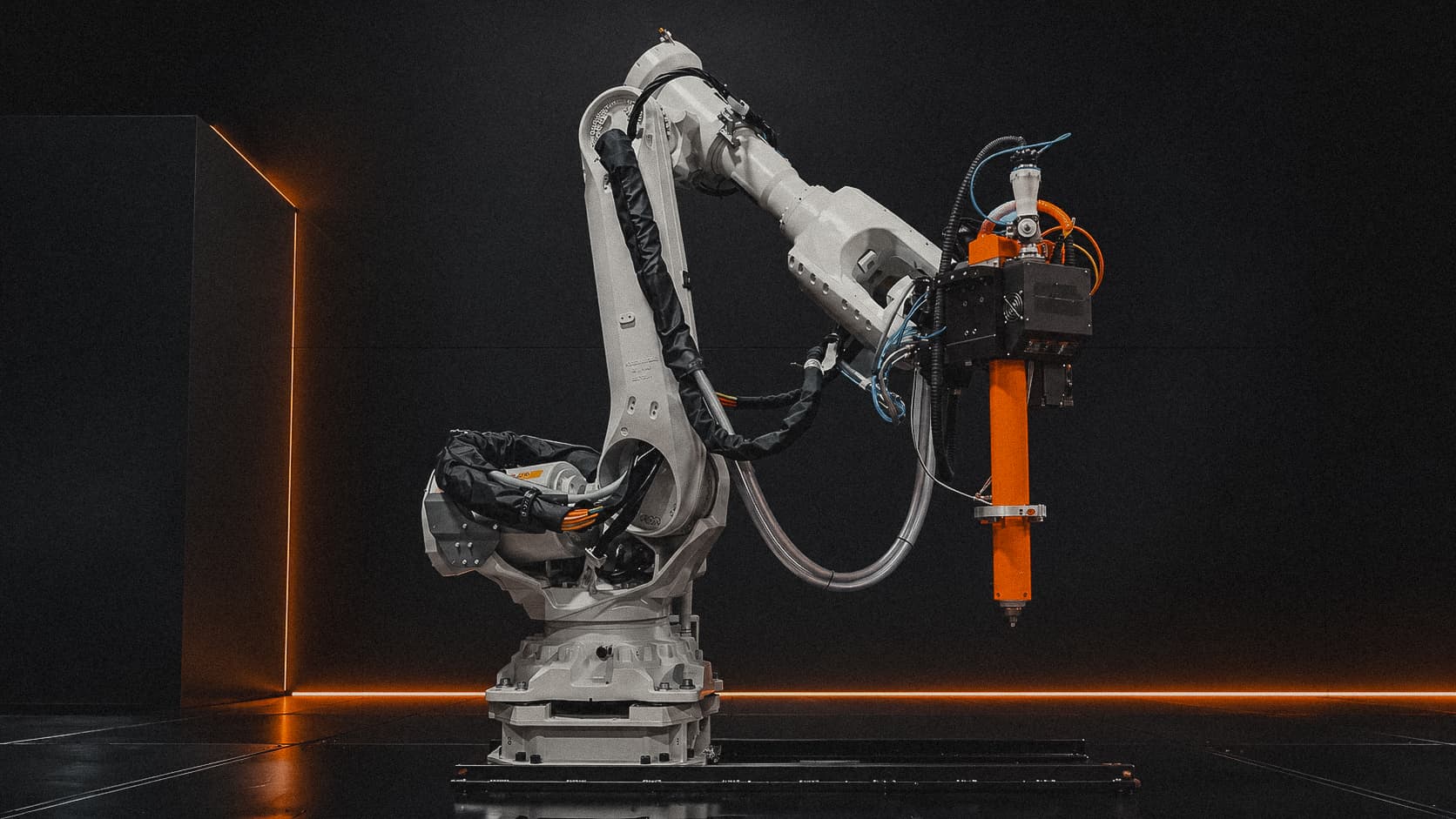
A robot arm,
a pellet extruder,
a linear rail.
An ABB 6-axis arm carries a Massive Dimension MDPE50 pellet extruder and rides a linear rail, so the print area is long, not boxed in. Pellets feed straight in, which keeps material cost down on big parts. When a build comes off the plate, it moves to the CNC side of the floor for finishing.
- Arm
- ABB 6-axis
- Extruder
- Massive Dimension MDPE50
- Runs
- Lights out, overnight
- Finish
- Machined to tolerance
Common questions
- What is large format additive manufacturing?
- LFAM is 3D printing at industrial scale. Instead of a small filament printer, an ABB 6-axis robot arm carries a pellet extruder on a linear rail, laying down big parts and tooling near-net. We then CNC machine the surfaces that need tolerance, all in one building.
- What materials do you print in?
- Pellet-fed polymers matched to the job: Dahltram T-100GF, a glass-filled tooling resin for composite mold faces, plus ABS-CF, PETG-CF, and PLA. The right grade for your part is confirmed on quote.
- How big a part can you print?
- This is large-format additive, and the extruder travels on a linear rail, so parts measured in feet are the target. The exact build envelope for your part is confirmed on quote.
- Do you machine the parts as well as print them?
- Yes. We print near-net, then CNC machine the surfaces that carry tolerance and finish, so you get a machined surface rather than an as-printed one.
- What file should I send for a quote?
- A 3D model is ideal, STEP or STL, and for a mold the outer mold line. If a drawing is all you have, send it and we will work from there.
Have a part
or a mold?
Send the geometry and the outer mold line. We will tell you the fastest way to make it and what it costs.